
Knowledge Library
Proactive Pool Care in San Antonio: Prevent Scale, Algae, and Costly Repairs
Owning a pool in San Antonio should make your backyard easier to enjoy, not harder to manage. But local conditions make pool care here more demanding than in many other markets.
Extreme heat, intense UV exposure, sudden storms, and hard water all put pressure on your pool’s chemistry and equipment. Chlorine can disappear quickly, calcium scale can build up on tile and plaster, and pumps or heaters may begin showing signs of strain during peak swim season.
That is why reactive pool maintenance is so expensive in South Texas. Waiting until the water turns cloudy, algae appears, or equipment starts failing usually means the problem has already been developing for days, weeks, or longer.
Worse, many homeowners, and even some service providers, unintentionally make the problem harder to solve by treating symptoms without understanding the underlying water balance.
Proactive pool care prevents small issues from becoming major repairs.
Why San Antonio Pools Need Proactive Maintenance
San Antonio pools face two major challenges: the climate and the water.
San Antonio heat and UV exposure increase chlorine demand. A sanitizer level that looks fine early in the week can drop too low if the pool is not being monitored and adjusted correctly. Once chlorine falls behind, cloudy water and algae can follow quickly.
Many pool owners try to protect chlorine from the sun by increasing cyanuric acid, or CYA, to 70, 80, or even 90 ppm. Higher CYA levels are not inherently dangerous, but excessive stabilizer can reduce chlorine’s active effectiveness. That means the pool may require a higher free chlorine level to maintain proper sanitation and fight organic material in the water.
The water itself creates another challenge. San Antonio water is commonly classified as very hard because regional groundwater passes through limestone and carries minerals such as calcium and magnesium. Every time a pool is filled or topped off, more minerals enter the water.
Then the Texas sun evaporates water from the pool. The water leaves, but the calcium stays behind, increasing the ppm. Over time, calcium levels can climb, making the pool more prone to white scale, rough plaster, cloudy water, and equipment stress.
That does not mean calcium is automatically a problem. In fact, calcium is part of balanced pool water. The issue is whether the total water chemistry is managed correctly. In San Antonio, pool care is not just about keeping the water clean. It is about managing heat, evaporation, sanitizer loss, calcium hardness, and water balance at the same time.
The Cost of Reactive Pool Care
Reactive pool care waits for visible symptoms:
- Cloudy water
- Green algae
- White calcium scale on tile or stone
- Rough plaster
- Rising filter pressure
- Poor circulation
- Pump or heater problems
By the time these issues are visible, the pool has often been out of balance for a while.
Calcium scale is one of the clearest examples. Scaling is not a surprise. Long before you notice a white, crusty buildup on your pool surfaces, your water chemistry is usually giving signs that it is moving out of balance.
Scale is also more than cosmetic. If scale is visible on pool surfaces, there is also a risk that buildup is forming where you cannot see it, including inside heaters, plumbing, filters, and circulation equipment. That buildup can reduce efficiency, restrict flow, and force equipment to work harder.
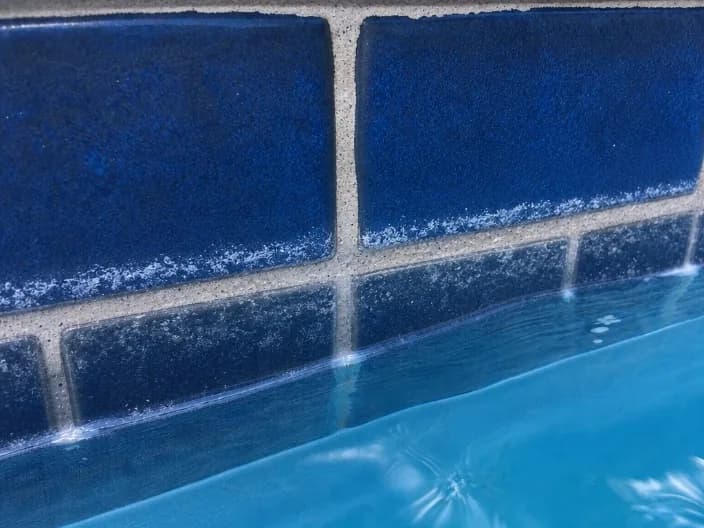
A neglected chemistry problem can become a costly equipment problem. A scaled heater, damaged pump, or rough pool surface can cost far more than consistent preventive care.
What Proactive Pool Care Looks Like
Proactive pool care treats the pool as a complete system. It is not just brushing, skimming, emptying baskets, and adding chlorine. Those tasks matter, but they are only part of proper maintenance.
At Barons and Buttons, we do not guess. We measure and track the conditions that determine whether your pool stays clear, balanced, and protected. We also maintain that data over time, allowing us to anticipate how your water is likely to behave before small shifts become visible problems.
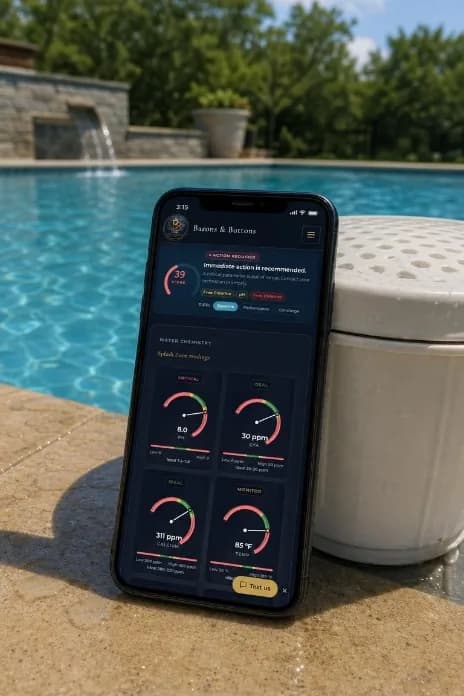
One of the tools we use is the Langelier Saturation Index, or LSI. LSI helps determine whether pool water is likely to deposit calcium scale or become corrosive to plaster, grout, and equipment.
The LSI calculation is consistent, but the result depends on the specific conditions of each pool. We factor in temperature, pH, calcium hardness, total alkalinity, cyanuric acid, and dissolved solids to understand whether the water is balanced, scaling, or corrosive.
In a hard-water market like San Antonio, that matters. Managing LSI helps protect the pool surface, tile, heater, plumbing, and circulation system before visible damage appears.
The Value of Pool Stewardship
You did not build a pool so you could spend your weekends fighting algae, scrubbing scale, testing water, or worrying about equipment failures. You built it to enjoy it.
That is the value of stewardship. It replaces surprise problems with measured, consistent care. It helps keep the water clearer, the surfaces smoother, the tile cleaner, and the equipment operating more efficiently.
For San Antonio homeowners, proactive pool care is not just a convenience. It is the maintenance strategy that fits the environment and can help prevent repair costs that reach thousands of dollars when scale, algae, or equipment problems are allowed to develop.
Schedule Proactive Pool Care in San Antonio
Barons and Buttons provides proactive pool care for San Antonio homeowners who want their pool managed with precision, consistency, and long-term protection in mind.
Schedule a complimentary pool care assessment and we will evaluate your water sanitation, water balance, calcium hardness, stabilizer level, and visible equipment conditions. You will receive a no-obligation report showing the current state of your pool water and the risks worth addressing before they become expensive repairs.
Frequently Asked Questions
Why does San Antonio pool water get calcium scale?
San Antonio water is naturally hard, and evaporation concentrates calcium in the pool over time. If the water balance is not managed correctly, calcium can deposit as white scale on tile, plaster, stone, and equipment.
How often should a pool be serviced in San Antonio?
Most San Antonio pools should be checked at least weekly, especially during hot months. Heavy use, full sun, storms, landscaping, and hard water can increase the need for consistent monitoring.
What is LSI in pool care?
LSI stands for Langelier Saturation Index. It helps determine whether pool water is balanced, scaling, or corrosive. Tracking LSI helps protect plaster, tile, heaters, plumbing, and other pool equipment.
What is the difference between reactive and proactive pool maintenance?
Reactive maintenance waits for problems like algae, cloudy water, scale, or equipment failure. Proactive pool care monitors chemistry, water balance, calcium levels, sanitizer performance, and equipment condition before problems become visible.